Australian Wildlife
Uluru at dusk — red sandstone and spinifex country against a pale evening sky

Independent · Australia-wide

The continent that kept its mammals strange

Marsupials, egg-laying monotremes, and a southern-ocean birdlife that still surprises people who thought they already knew kangaroos. Species first, photographs second, parks rules always.

At a glance

Living monotreme families
2
Native mammals that are marsupials
~70%
Last captive thylacine
1936
National listing law
EPBC
When many species actually move
Dusk
The only viewing technique
Distance

What is Australian wildlife?

Australian wildlife is the living fauna of a continent that split from Gondwana and then spent tens of millions of years inventing mammals that raise young in pouches — and two that still lay eggs. The platypus and the short-beaked echidna are the world’s only living monotremes. Kangaroos, wallabies, wombats, koalas, quolls, and the Tasmanian devil are marsupials. That is not a trivia line. It is the reason a visitor who treats a koala like a teddy, or a kangaroo like a petting-zoo extra, misunderstands the animal in front of them.

What is this site for? Species guides with scientific names, a public conservation listing you can re-check, range in plain language, and the viewing ethics that keep a wild animal wild. Region pages explain why a greater bilby story belongs in the arid and semi-arid zone, why little penguins are a southern-coast dusk event, and why Top End wetlands are a different country from the Wet Tropics.

This is an independent education hub on australianwildlife.com.au — not a parks authority, not a zoo, and not a rescue service. We do not invent live opening hours, parade times, or ticket prices. Historic addresses that earned links — /BILBY.htm, /BANDICOOT.htm, /TASMANIAN_DEVIL.htm and the rest — 301 to ranking slugs such as /bilby/, /bandicoot/, and /tasmanian-devil/.

If you need injured-wildlife help, call your local rescue organisation. If you need a listing status for a citation, open DCCEEW or the IUCN Red List and verify the current assessment. This page is a starting map, not a substitute for either.

How to use the hub: start with a definition when the word itself is the query — [marsupial](/marsupials/), [bush tucker](/australian-bush-tucker-guide/), [Riversleigh](/riversleigh-fossils/). Start with a ranking slug when you already know the animal — /kangaroos/, /echidnas/, /bilby/. Start with [regions](/regions/) when you are planning a trip and need the habitat before the species. Start with [conservation](/conservation/) when you need the listing instrument, not a slogan. The [FAQ](/faq/) inherits the old Ask Dr Ann taxonomy so /ask_birds.htm and /ask_reptiles.htm still resolve.

Official geography and access belong to Parks Australia and the state and territory parks services. Licensed zoos and aquariums that participate in cooperative breeding sit under the Zoo and Aquarium Association — this site will not rank “best wildlife parks.” Occurrence records belong on the Atlas of Living Australia. We cite those sources because they are public and revisable. We do not invent a dusk parade time, a ferry, or a rescue outcome.

Highlights

Six reasons this fauna is unlike anywhere else

Most visitors come for a kangaroo and a koala. They stay because the continent’s fauna is older, stranger, and more fragile than a souvenir shop suggested.

  1. A continent of pouches

    Most of Australia’s native land mammals are marsupials. Young are born tiny and finish development attached to a teat, often in a pouch. That is why a kangaroo joey is not a “baby kangaroo you can hold” and why orphan myths belong with licensed carers, not the side of the highway.

  2. Egg-laying mammals still exist

    The platypus and short-beaked echidna are the world’s only living monotremes. They lay eggs, produce milk, and occupy a branch of mammal evolution found nowhere else as a living fauna. Seeing one is a privilege of quiet water and patience, not a booked encounter.

  3. Birds that own the dusk

    Little penguins — the smallest penguin species — come ashore after dark on southern coasts. Rainbow lorikeets turn suburban figs into noise. Neither is a prop. Flash, feeding, and leaving the platform are how visitors become the management problem.

  4. Reptiles built for heat and camouflage

    Shinglebacks, blue-tongued skinks, perenties, and death adders are not interchangeable “lizards.” Some are slow and curious; one is a sit-and-wait elapid. Identification first. Hands never.

  5. Recovery is a real, unfinished project

    The greater bilby is a national conservation emblem because the species collapsed across most of its former range. Tasmanian devil facial tumour disease is a transmissible cancer, not a metaphor. Status is a public fact — re-check it.

  6. Country, not a theme park

    Habitats run from monsoon wetlands to alpine herbfields. Traditional Owners have managed this country for tens of thousands of years. Parks rules, seasonal closures, and “no dogs” signs are the visit, not an inconvenience on the way to the visit.

A koala gripping a eucalyptus trunk, looking toward the camera

The tree-dweller

Koalas are not bears — and they are not fine everywhere

The koala (Phascolarctos cinereus) is a tree-living marsupial, not a bear. In 2022 the Australian Government listed the combined Queensland, New South Wales and Australian Capital Territory populations as Endangered under the EPBC Act. Victoria and South Australia are assessed separately.

They sleep most of a 24-hour cycle because eucalyptus leaves are a poor, toxic diet. A traveller who shakes a tree for a photograph is not “waking a cute animal” — they are interrupting an animal that already lives on a thin energy budget.

Distance, quiet, and staying on the track are the whole technique. If you cannot see the animal without leaving the path, you did not see it.

Koala species guide
A platypus swimming at the surface of a shaded creek

The living fossil people still argue about

A duck-billed mammal that lays eggs

The platypus (Ornithorhynchus anatinus) and the short-beaked echidna are the world’s only living monotremes — mammals that lay eggs. Males carry a venomous spur. The bill is an electroreceptor, not a joke about evolution.

Dawn and dusk on a quiet eastern creek are when people actually see one. Splash, dogs, and a crowd on the bank are why most people do not. The species is still widespread, but local declines and drying waterways are documented in public assessments.

Do not invent a “guaranteed viewing” stop. Treat a platypus as a privilege of patience, then read the species page before you plan a weekend around one.

Platypus guide
A little penguin standing on coastal rock

After dark on the southern coast

Little penguins — the smallest penguin on Earth

Eudyptula minor is the world’s smallest penguin, breeding on southern Australian coasts and islands — including well-known colonies in Victoria and Tasmania. They come ashore after dusk. Flash photography and leaving the platform are how visitors become the problem the colony is already managing.

Phillip Island Nature Parks and Parks Tasmania publish the current rules. This site will not invent parade times. If you want the species, start with the biology; if you want a night out, book the official venue and stay on the path.

Little penguin guide

Featured species

Start with animals people actually search

Deep guides with scientific names, public listing status, and viewing ethics — not thin cards. The classic .htm paths still redirect here.

A common wombat standing on grass

marsupial

Common wombat

Vombatus ursinus

The common wombat (Vombatus ursinus) is a large, burrowing marsupial of south-eastern Australia and Tasmania. It grazes grasses at dusk and night, leaves distinctive cube-shaped scats, and can weigh more than 30 kilograms. It is listed Least Concern globally — and still dies on roads in numbers that shock first-time visitors.

Learn more
A greater bilby standing on sand

marsupial

Greater bilby

Macrotis lagotis

The greater bilby (Macrotis lagotis) is a Vulnerable nocturnal marsupial in the bandicoot order (Peramelemorphia). It once occupied much of arid and semi-arid Australia. Foxes, cats, rabbits, and habitat change reduced it to scattered inland populations and conservation refuges. It is the animal conservation groups ask Australians to remember at Easter.

Learn more
A humpback whale surfacing

mammal

Humpback whales

Megaptera novaeangliae

Humpback whales (Megaptera novaeangliae) migrate along Australia’s east and west coasts between Antarctic feeding grounds and tropical breeding waters. On the east coast the northward pulse is generally late autumn into winter and the return is spring — exact weeks vary by latitude and year. This page will not invent a “best weekend.” Historic /humpback.htm and /features/humpback.htm redirect here.

Learn more
A red kangaroo standing in open Australian rangeland

marsupial

Kangaroo

Macropus rufus and relatives

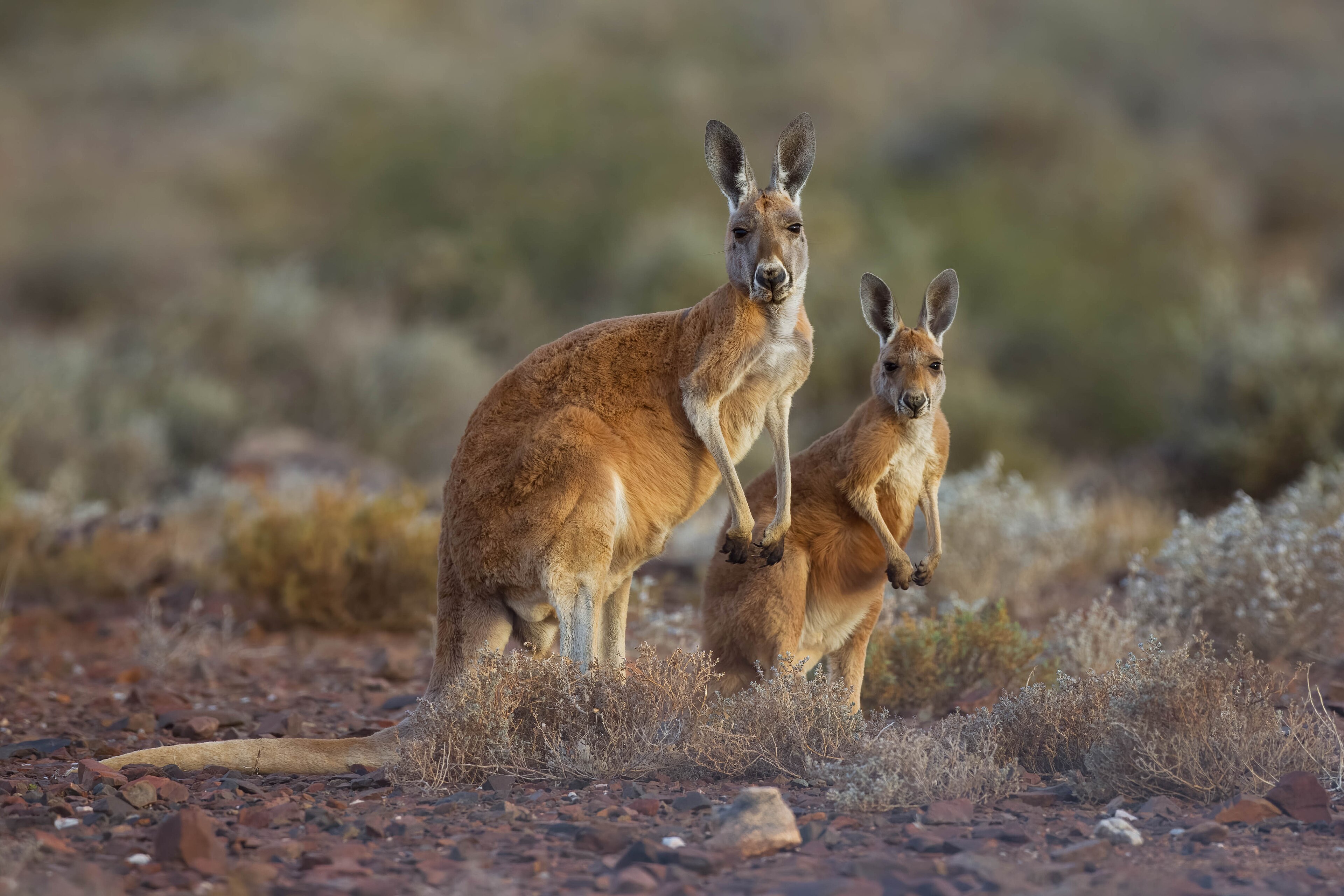
Kangaroos are large macropod marsupials. The red kangaroo (Macropus rufus) is the world’s largest living marsupial; eastern grey (Macropus giganteus) and western grey (Macropus fuliginosus) kangaroos are the other big, familiar species. They hop, they raise tiny young in a pouch, and they can injure people who treat them as picnic extras.

Learn more
A koala gripping a eucalyptus trunk

marsupial

Koala

Phascolarctos cinereus

The koala (Phascolarctos cinereus) is a tree-living marsupial endemic to eastern Australia. It is not a bear. In February 2022 the Australian Government listed the combined Queensland, New South Wales and Australian Capital Territory populations as Endangered under the EPBC Act. Victoria and South Australia are assessed separately — always re-check DCCEEW.

Learn more
A little penguin standing on coastal rock

bird

Little penguin

Eudyptula minor

The little penguin (Eudyptula minor), also called the fairy penguin, is the world’s smallest penguin species. It breeds on southern Australian coasts and islands and in New Zealand. Birds come ashore after dusk. Flash photography and leaving the platform are how visitors become the colony’s problem.

Learn more

How to use this hub

Three ways into the country

Three honest ways in — learn one animal properly, understand the habitat that still holds it, or read the conservation argument before you book a photo tour.

Learn one species properly

Essential

Learn one species properly

Pick a kangaroo, koala, bilby, or platypus page. Read the scientific name, the listing, and the viewing notes before you plan a weekend around a sighting.

Learn more
Match the animal to the country

Habitats

Match the animal to the country

Top End wetlands, Wet Tropics, the arid centre, temperate forests, alpine country, and the southern coast — wildlife is a geography problem first.

Learn more
Conservation without the brochure

Stewardship

Conservation without the brochure

Invasive species, habitat loss, disease, and what a visitor can actually do — cats contained, distance kept, reputable groups supported.

Learn more

Questions

Questions people actually ask

Direct answers first — the questions people type into search and ask assistants.

Living monotremes (platypus and echidna), most of the world’s marsupial diversity, and many endemic birds and reptiles. Kangaroos, koalas, wombats, Tasmanian devils, and the greater bilby are the familiar set — uniqueness is the fauna, not a souvenir.

Read the animal before you chase the photograph

Start with a species guide, then the region it actually lives in. Conservation status is a public fact, not a mood.