Marsupial
Kangaroos — the large hoppers Australia is named for in every postcard
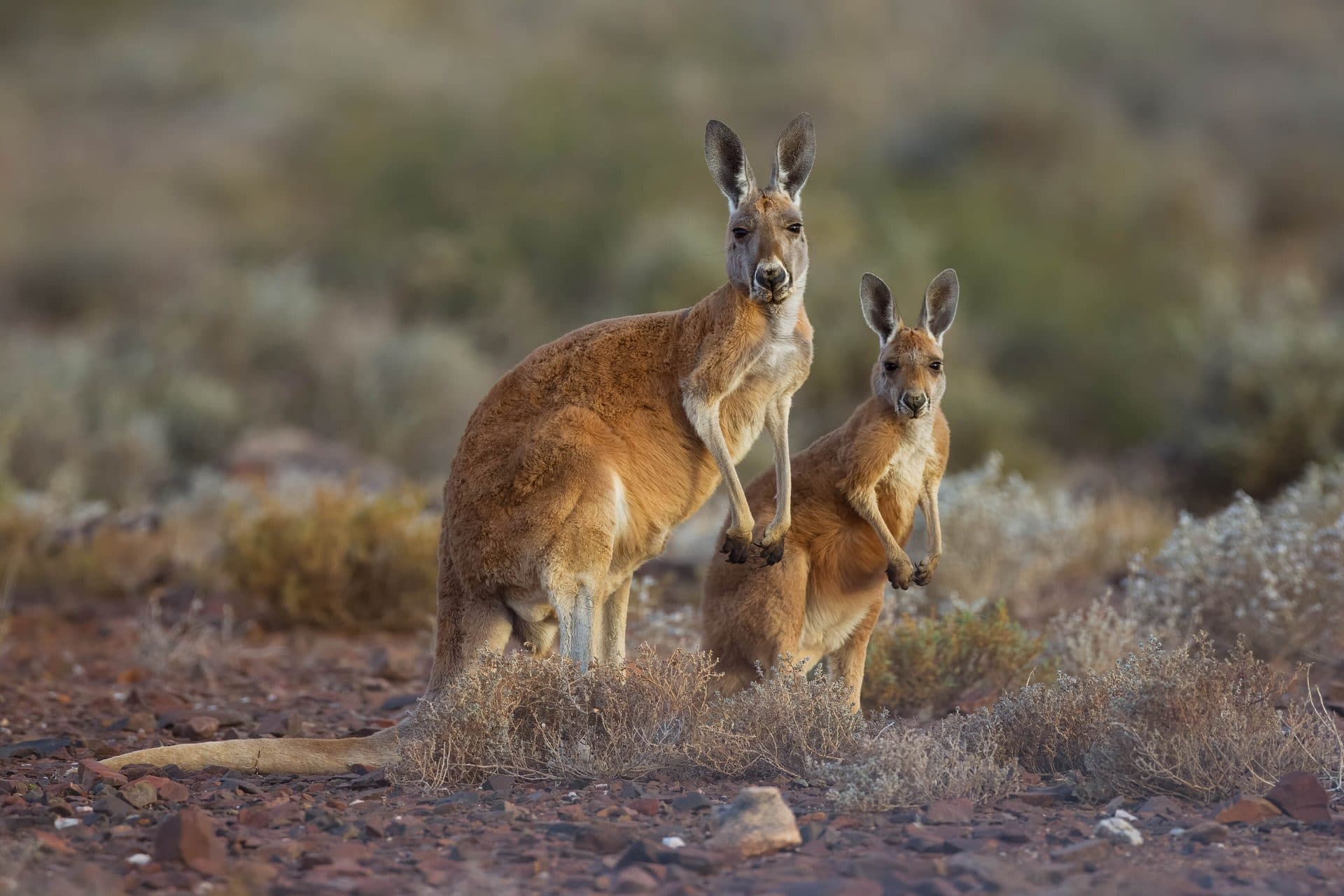
Red kangaroos own the inland plains. Eastern and western greys own the better-watered forests and farmland. None of them are pets.
- Red kangaroo
- M. rufus
- Living marsupial
- Largest
- Young finish there
- Pouch
- Visitor rule
- Never feed
Kangaroos are large macropod marsupials. The red kangaroo (Macropus rufus) is the world’s largest living marsupial; eastern grey (Macropus giganteus) and western grey (Macropus fuliginosus) kangaroos are the other big, familiar species. They hop, they raise tiny young in a pouch, and they can injure people who treat them as picnic extras.
Definition
Macropod. A member of the kangaroo family (Macropodidae) — kangaroos, wallabies, wallaroos, pademelons, and tree-kangaroos. The name means “big foot.”
The short identification
Red kangaroo — inland plains and rangelands; males rusty, females often blue-grey (“blue flyers”).
Eastern grey — eastern forests, woodland, and farmland; shaggy grey-brown.
Western grey — southern and western woodlands; browner, with a distinctive curry-like odour to some observers.
Wallaroos and euros sit between kangaroo and wallaby in size and like rocky slopes. Pademelons are the small, forest-edge hoppers.
The historic page /Kangaroos_and_their_relatives.html now lands on kangaroos and their relatives. /kangaroo.htm lands here.
Biology that changes how you watch
Kangaroos are foregut fermenters eating grasses and forbs. In heat they lick their forearms and rest in shade. They are most visible at dusk and dawn — which is also when cars kill them.
Reproduction is the marsupial pattern: a tiny neonate crawls to a teat. Females can have a joey at foot, one in the pouch, and a delayed embryo — embryonic diapause — waiting. That is a public textbook fact, not an invitation to inspect pouches.
Surveys and numbers
Aerial survey of kangaroos is a specialist field. The old /accuracy_of_kangaroo_surveys.htm article pointed at that debate. Harvest quotas, where they exist, are a state regulatory matter. This site will not invent a national headcount.
Viewing
Stay in the car where parks ask you to. Do not form a feeding circle. If a male stands up and scrapes, leave. Dogs belong on leads or at home.
Read photography ethics before you walk toward a mob for a silhouette.
Range, without a secret pin
Red kangaroos occupy inland plains and rangelands across much of the arid and semi-arid zone. Eastern greys occupy the better-watered forests, woodland, and farmland of the east. Western greys occupy southern and western woodlands. Overlap exists. A golf-course edge in a regional town is not a separate species.
Parks Australia and state parks services manage many of the places people actually stop. Stay in the vehicle where they require it. Do not invent a “best national park for kangaroos” ranking — macropods are widespread, and the ethic does not change with the postcode.
The kangaroos and their relatives hub places wallabies, wallaroos, pademelons, and potoroids in the same superfamily. This page is the large hoppers.
What a visitor gets wrong
They offer bread. They walk toward a joey. They assume a male that approaches is friendly. They stop in a travel lane at dusk for a silhouette. They treat a habituated campground animal as a template for a wild mob.
Large males kick and scratch. People are injured every year around food and drought. Dogs on leads still chase. A kangaroo in a backyard is a management problem for the household and the council — not a pet-in-waiting.
If you find an orphaned joey, call a licensed rescue organisation. Do not feed cow’s milk. Do not keep the animal overnight “until morning” if you can reach a carer. This site is not that carer.
Listings and harvest
Most large kangaroo species are assessed as Least Concern on the IUCN Red List. That sentence is not a permit to treat them as scenery. State harvest quotas, where they exist, are a regulatory matter with their own reports. This page will not invent a national headcount. The old /accuracy_of_kangaroo_surveys.htm path pointed at that debate and now 301s here.
Verify any status line before you cite it. “Least Concern” globally can still sit beside local welfare and vehicle-strike problems.
Official starting points
DCCEEW for national biodiversity context. The IUCN Red List for global assessments. The Atlas of Living Australia for occurrence. Parks pages for the place you are standing. Licensed Zoo and Aquarium Association members if you want an education animal under published welfare standards — not a ranking of “best parks.”
Questions
Questions people actually ask
The red kangaroo (Macropus rufus) is the largest living marsupial. Large males can stand taller than a person and weigh around 90 kilograms — published maxima vary; treat any exact number as something to check.